
From terrifying disguises and ghostly visitors to bizarre love predictions, discover the Halloween traditions that prove real history can be stranger than any horror movie.
Imagine standing alone in a dark room at midnight, holding a candle and staring into a mirror, hoping to see the face of someone you haven’t met yet.
Or picture a group of villagers running home from a dying bonfire because they believe a monstrous black pig is about to emerge from the darkness.
Sounds like something from a horror movie, right?
Believe it or not, these are examples of traditions and folklore connected to Halloween celebrations throughout history.
Long before Halloween became a holiday filled with elaborate costumes, pumpkin decorations, haunted houses, and mountains of candy, it was surrounded by mysterious beliefs about death, love, spirits, and the future.
For centuries, people across different cultures believed that certain autumn nights offered extraordinary opportunities: the dead might return, supernatural creatures might wander among the living, and ordinary objects could supposedly reveal secrets about the coming year.
Some traditions were frightening. Others were surprisingly romantic. And a few were so bizarre that they sound completely invented.
Let’s travel through history and explore some of the strangest Halloween traditions ever recorded.
1. Samhain: The Night When the Living and the Dead Could Meet
- 1. Samhain: The Night When the Living and the Dead Could Meet
- 2. Dressing Like a Monster to Avoid Becoming a Victim
- 3. The Original Jack-o'-Lanterns Were Much More Terrifying Than Pumpkins
- 4. Souling: When People Knocked on Doors for the Dead
- 5. The Midnight Mirror Ritual: Seeing Your Future Husband
- 6. Apple Peels That Supposedly Revealed Your Soulmate
- 7. Pulling Kale and Burning Nuts to Predict Love
- 8. Barmbrack: The Halloween Cake That Predicted Your Destiny
- 9. Wales and the Terrifying Legend of the Tail-Less Black Sow
- 10. Pangangaluluwa: The Singing Ghosts of the Philippines
- 11. Sardinia's Tradition of Collecting Gifts for the Souls
- 12. Halloween Parties Used to Be Obsessed With Predicting the Future
- Why Were Halloween Traditions So Strange?
- Final Thoughts: The Real History of Halloween Is Stranger Than Any Horror Movie
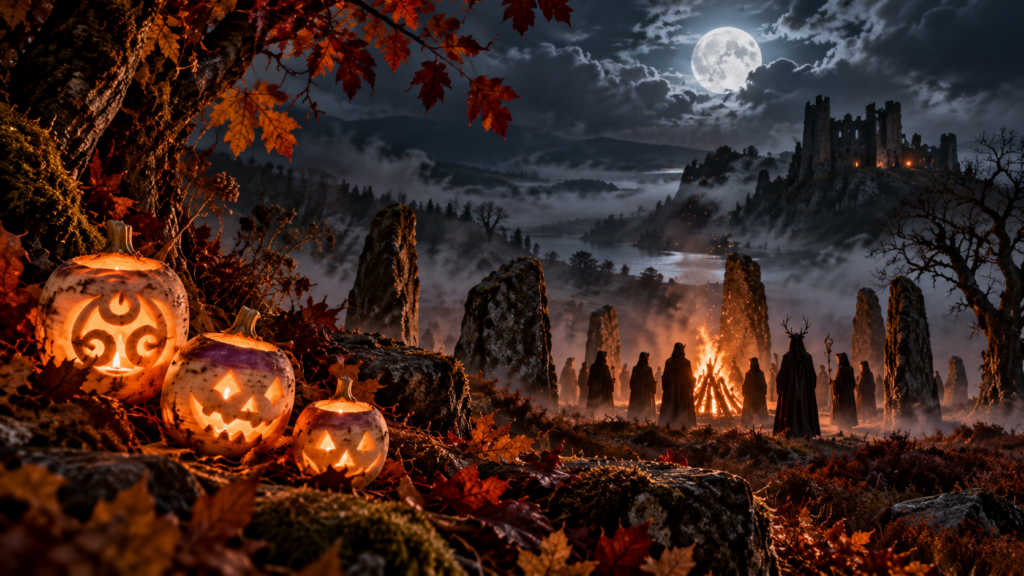
Before Halloween became a modern celebration, people in Ireland and other Gaelic communities observed Samhain, a seasonal festival marking the transition from the harvest season into winter.
In the traditional Irish calendar, November 1 marked the beginning of winter, with celebrations taking place the evening before.
But this was more than a seasonal gathering.
According to folklore, the boundary between the human world and the supernatural world became unusually thin around Samhain.
The dead might return to visit their former homes, while mysterious beings could roam through the countryside.
Imagine living hundreds of years ago without electric lights, surrounded by dark forests, isolated farms, and unfamiliar sounds outside your home.
Suddenly, the idea that something supernatural might be waiting beyond your door becomes a little easier to understand.
Families celebrated with seasonal foods and games, while communities observed customs intended to protect homes and people from harm.
The strange part? Halloween was not originally just about frightening people for entertainment. For some communities, the possibility of encountering spirits was a genuine part of their worldview.
2. Dressing Like a Monster to Avoid Becoming a Victim
Today, Halloween costumes are an opportunity to become absolutely anything.
A vampire. A witch. A movie character. A giant inflatable dinosaur.
But historical disguises sometimes had a much more unsettling purpose.
In Ireland and Scotland, people practiced forms of guising, dressing in masks or unusual clothing and visiting neighboring homes.
Some folklore associated disguises with protection from wandering spirits or fairies. By hiding their identities or resembling supernatural beings, people hoped to avoid unwanted attention.
Traditional guisers might also entertain householders with songs, jokes, stories, or performances in exchange for food or small gifts.
This custom helped shape the broader history of modern trick-or-treating, although today’s tradition developed from several influences.
And unlike today’s carefully coordinated Halloween outfits, older costumes could be deliberately disturbing.
Masks were sometimes homemade, grotesque, and designed to frighten anyone unfortunate enough to encounter them.
Imagine opening your front door at night and discovering a group of unrecognizable figures standing outside.
No doorbell camera. No explanation.
Just masks, strange voices, and an expectation that you should give them something.
3. The Original Jack-o’-Lanterns Were Much More Terrifying Than Pumpkins
When someone mentions Halloween, a glowing orange pumpkin is probably one of the first images that comes to mind.
But the earliest versions of the familiar jack-o’-lantern looked very different.
In Ireland and Scotland, people traditionally carved frightening faces into turnips.
Yes, turnips.
They hollowed out these root vegetables, cut disturbing expressions into their surfaces, and sometimes placed candles inside.
The result was a ghostly face illuminated from within.
These lanterns were associated with frightening away unwelcome supernatural visitors, as well as providing a perfect opportunity to scare unsuspecting neighbors.
One famous Irish folktale tells the story of Stingy Jack, a trickster condemned to wander after death, carrying a light inside a hollowed turnip.
When Irish immigrants brought their traditions to North America, pumpkins became a popular alternative because they were larger and easier to carve.
And that’s how the cheerful orange Halloween decoration we recognize today developed from something considerably more sinister.
Fun fact: Some surviving traditional turnip lanterns look far more unsettling than their modern pumpkin counterparts.
4. Souling: When People Knocked on Doors for the Dead
Long before children shouted “Trick or treat!”, people in parts of medieval Britain participated in a tradition known as souling.
Around the Christian observances of All Saints’ Day and All Souls’ Day, individuals could visit homes requesting small cakes known as soul cakes.
But there was a condition.
In exchange for food, the visitor would offer prayers for departed souls.
The belief was connected to the Christian understanding of purgatory and the possibility that prayers could help the dead.
A soul cake was therefore more than an ordinary snack.
It was part of a religious exchange involving the living and the deceased.
Imagine someone appearing outside your home and asking for a cake because they intended to pray for someone who had died.
To modern ears, it sounds extraordinary.
Yet customs like souling reveal how closely food, faith, charity, and remembrance were once connected.
Modern trick-or-treating has a more complicated history, but souling is one important part of that story.
5. The Midnight Mirror Ritual: Seeing Your Future Husband
Forget dating apps.
In the nineteenth and early twentieth centuries, some Halloween fortune-telling games promised something considerably more dramatic.
They supposedly allowed you to see your future spouse.
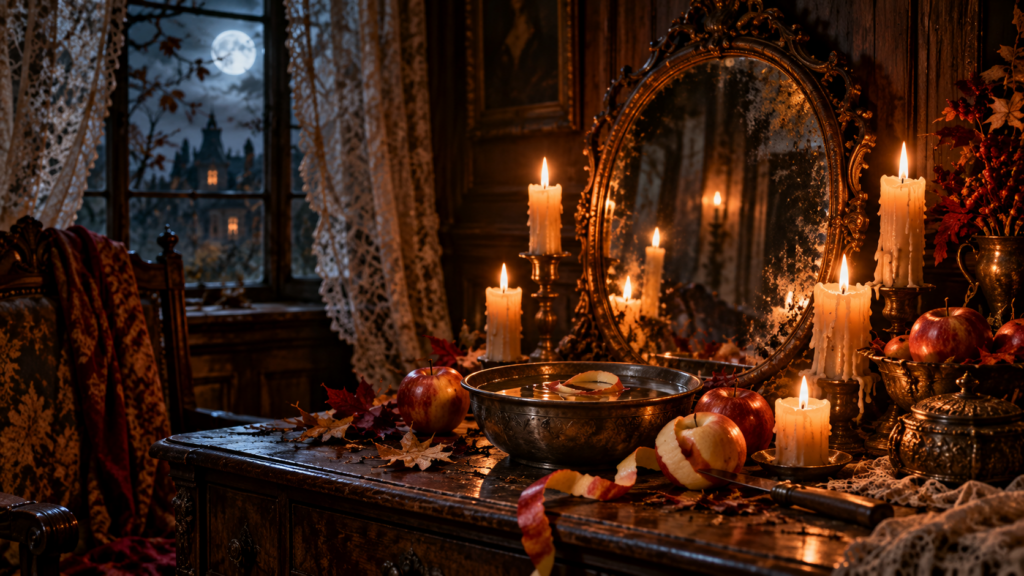
One recorded custom involved entering a dark room, looking into a mirror, and using candlelight while performing the ritual.
In certain versions, the participant also ate an apple.
According to the superstition, the face of a future husband might appear in the reflection, sometimes just over the participant’s shoulder.
Romantic?
Possibly.
Terrifying?
Absolutely.
Imagine being alone at midnight, staring into a dimly illuminated mirror while waiting for another face to appear.
The ritual was especially associated with young women, reflecting a period when marriage occupied an enormous place in social expectations.
By the early twentieth century, mirror divination had become a popular theme in Halloween illustrations, postcards, and party games.
Whether people genuinely believed the predictions or simply enjoyed frightening one another varied.
Fortunately, there is no evidence that mirrors can reveal future romantic partners.
But the tradition remains a wonderfully eerie example of how Halloween once mixed romance with supernatural suspense.
6. Apple Peels That Supposedly Revealed Your Soulmate
Apples were once much more than a healthy seasonal snack.
In traditional Halloween fortune-telling, they could supposedly reveal romantic secrets.
One unusual game involved peeling an apple in one long, unbroken strip.
The participant would then throw the peel over their shoulder.
After it landed, everyone examined its shape.
According to the superstition, the peel would resemble a letter of the alphabet.
That letter was supposed to be the first initial of the participant’s future spouse.
Imagine receiving an entire romantic prediction from a piece of fruit.
And what if the peel looked like absolutely nothing?
Perhaps fate simply wasn’t feeling cooperative.
Apples also appeared in other Halloween games, including apple bobbing and attempts to catch dangling fruit using only one’s teeth.
Some versions were associated with luck, courtship, and marriage predictions, while others were enjoyed simply as party entertainment.
What makes these traditions fascinating is how ordinary harvest foods became objects of mystery.
For people fascinated by the future, even an apple could become a fortune teller.
7. Pulling Kale and Burning Nuts to Predict Love
If apple peels weren’t convincing enough, Scottish Halloween folklore offered even stranger romantic tests.
One involved a vegetable that modern people usually associate with salads and smoothies.
Kale.
According to a custom described in Robert Burns’s eighteenth-century poem Halloween, participants could enter a field after dark and pull a kale stalk from the ground without looking.
The stalk supposedly revealed details about a future partner.
Its length and shape could indicate the person’s appearance.
Even the soil attached to its roots mattered.
A generous amount of earth suggested a wealthy spouse.
Who knew finding love could involve so much gardening?
Another Scottish tradition involved placing nuts in a fire to represent two people in a relationship.
The way the nuts burned supposedly revealed their compatibility.
If they burned steadily, the couple could expect harmony.
If they reacted noisily or unpredictably, the relationship might be troubled.
Essentially, these were historical compatibility tests performed with vegetables and fire.
They were not scientifically meaningful, of course, but they reveal an entertaining truth about human nature.
People have always wanted to know whether their relationships will work out.
8. Barmbrack: The Halloween Cake That Predicted Your Destiny
Imagine attending a Halloween gathering and discovering that your dessert supposedly contains clues about your future.
In Ireland, a traditional fruit loaf called báirín breac, commonly known as barmbrack, became associated with Halloween fortune-telling.
Small symbolic objects were sometimes hidden inside the loaf.
The meaning depended on which object appeared in a person’s portion.
A ring commonly predicted marriage.
A coin suggested future wealth.
A rag could represent poverty.
Other traditional objects included a thimble, button, or stick, each carrying its own fortune.
Of course, the meanings varied between regions and households.
The tradition made eating cake feel like participating in a mysterious lottery.
Would your slice promise romance, financial success, or something much less appealing?
Barmbrack remains a familiar part of Irish Halloween food culture, although many modern versions simply include a ring.
Naturally, actual objects hidden inside food can be choking hazards, so any modern recreation needs to be handled safely.
Still, there is something wonderfully imaginative about a tradition that transforms dessert into a prediction of your entire future.
9. Wales and the Terrifying Legend of the Tail-Less Black Sow
Some Halloween folklore is so strange that it sounds like a horror writer invented it.
In Wales, the traditional festival of Nos Galan Gaeaf marked the eve of winter.
The occasion was associated with seasonal feasts, bonfires, and stories about supernatural visitors.
Among the most frightening characters was Hwch Ddu Gwta, a monstrous black sow without a tail.
According to Welsh folklore, the creature could appear as the bonfire died down and threaten those who remained outside too long.
In some accounts, it was accompanied by Ladi Wen, a mysterious White Lady, sometimes described as headless.
Children were warned to hurry home before the terrifying creature appeared.
Imagine spending the evening celebrating around a bonfire, only to hear adults warning everyone that a monstrous animal might emerge from the darkness.
Suddenly, walking home becomes a very urgent matter.
These legends belonged to a wider tradition of storytelling in which the transition into winter was surrounded by mysterious and potentially dangerous forces.
Today, they offer a fascinating glimpse into the supernatural imagination of historical Welsh communities.
And perhaps they also provided a remarkably effective way of persuading children not to stay out too late.
10. Pangangaluluwa: The Singing Ghosts of the Philippines
Halloween-like traditions were not limited to Europe.
In the Philippines, a traditional custom called pangangaluluwa became associated with the period around All Saints’ Day and the remembrance of the dead.
Groups of people would travel from house to house singing songs, sometimes dressed in white or presenting themselves as wandering souls.
The songs could request prayers, food, or offerings.
Households might respond with rice cakes and other traditional treats.
Unlike modern trick-or-treating, pangangaluluwa was closely linked to religious beliefs and remembrance.
Its focus was not simply obtaining sweets.
It reflected the relationship between communities and departed souls during the annual observances surrounding Undas, the Filipino season of remembrance.
The practice has declined in many places, but it remains an important part of Filipino cultural heritage.
Imagine walking through a quiet neighborhood at night and hearing a group of white-clad figures singing outside a house.
Without knowing the tradition, the scene could seem genuinely supernatural.
But behind the ghostly appearance was a meaningful custom involving faith, generosity, and community.
11. Sardinia’s Tradition of Collecting Gifts for the Souls
On the Italian island of Sardinia, communities have long observed their own distinctive customs connected with the remembrance of the dead.
Depending on the region, these traditions are known by names such as Is Animeddas or Su Mortu Mortu.
One particularly interesting feature involves children visiting homes and requesting gifts or food in connection with the souls of the departed.
Historically, households might offer nuts, chestnuts, fruit, bread, or traditional sweets.
These visits were connected to beliefs about honoring the dead and the spiritual significance of the season.
Although the practice resembles trick-or-treating in certain ways, it has its own local history and cultural meaning.
Sardinia does not have one single, universal version of this tradition.
The names, songs, offerings, and customs can differ considerably from village to village.
And that is part of what makes it fascinating.
While modern Halloween celebrations often look increasingly similar around the world, older regional customs preserve distinctive ways of understanding life, death, family, and memory.
12. Halloween Parties Used to Be Obsessed With Predicting the Future
Today, a successful Halloween party might involve creative costumes, horror movies, music, and impressive decorations.
But historical Halloween parties could have a very different focus.
Especially in nineteenth- and early twentieth-century Britain and America, fortune-telling games became popular seasonal entertainment.
Guests might test their romantic compatibility using nuts, attempt to identify future lovers through apple peels, or participate in strange mirror rituals.
Some party games involved candles or symbolic objects that supposedly offered clues about marriage and good fortune.
These activities were often presented as playful entertainment, but their appeal came from older supernatural beliefs.
And many of them revolved around one question.
What does the future hold?
For generations living in a world with fewer opportunities to control or predict what came next, these customs offered a mixture of hope, amusement, uncertainty, and fear.
Halloween became the perfect occasion to explore those feelings.
After all, if there was one night when the ordinary rules of the world might not apply, why not use it to discover a secret about tomorrow?
Why Were Halloween Traditions So Strange?
Looking back, many historical Halloween customs appear bizarre.
But their meanings become clearer when we consider the worlds in which they developed.
The end of the harvest marked an important turning point.
Winter brought darkness, colder weather, food concerns, and genuine uncertainty about survival.
Death was often a more visible part of everyday life, while local folklore offered explanations for things people could not easily understand.
That helps explain why so many traditions centered on protection, remembrance, and the possibility of communicating with the supernatural.
Fortune-telling rituals served another purpose.
They gave people a playful way to explore questions about love, wealth, marriage, and the unknown future.
And customs involving costumes, visits, songs, and shared food helped strengthen community bonds.
Different societies developed different traditions, and not every autumn remembrance festival is a form of Halloween. Each custom deserves to be understood within its own cultural and religious history.
Still, certain themes appear repeatedly: the changing seasons, the mystery of death, and humanity’s fascination with what cannot be seen.
Final Thoughts: The Real History of Halloween Is Stranger Than Any Horror Movie
The next time you carve a pumpkin, put on a costume, or attend a Halloween party, remember that these familiar activities belong to a much larger history of extraordinary traditions.
People once carved frightening faces into turnips to ward off spirits.
They stared into mirrors at midnight hoping to glimpse their future spouses.
They burned nuts to test romantic compatibility, searched for fortune-telling objects inside cakes, and told stories about terrifying creatures waiting beyond the light of a bonfire.
Elsewhere, children sang as wandering souls or collected offerings in remembrance of the dead.
Some of these customs survive today. Others exist mainly in folklore, museums, historical records, and family stories.
But together, they reveal something remarkable.
Halloween has never been only about being scared. It has also been about love, memory, uncertainty, imagination, and the things human beings have always struggled to explain.
And perhaps the most fascinating part isn’t whether people ever encountered anything supernatural.
It’s how extraordinary their beliefs and traditions became.
So, here’s one final question:
Would you rather stare into a mirror at midnight to discover your future soulmate, or spend Halloween night running from the legendary tail-less black sow?
Choose carefully. History has already made both options surprisingly memorable.
Keep the Halloween Mystery Alive!
Not ready to leave the spooky season behind? Neither are we!
If you love mysterious legends, eerie stories, and a little Halloween excitement, there’s plenty more waiting for you.
Explore the darker side of history in our article, The Most Cursed Objects in History: Dolls, Mirrors, Paintings, and the Dark Stories Behind Them. From allegedly haunted dolls to mysterious paintings and mirrors with unsettling reputations, discover the real stories and chilling legends behind some of history’s most infamous objects.
And when you’re ready to trade ghost stories for a little entertainment, head over to Eternal Slots and explore our collection of exciting slot games. Who knows? You might just find your next favorite game hiding among the reels!
Because Halloween is all about embracing the unexpected, enjoying a little mystery, and discovering what surprises are waiting around the corner.
Stay curious, stay spooky, and let the Halloween fun continue! 🎃




Leave A Reply