
Some objects are worth a fortune. Others are treasured because they remind us of someone we love. And then there are objects that people would happily pay to have removed from their homes, preferably before sunset.
Throughout history, ordinary possessions have developed extraordinary reputations. Dolls have allegedly moved without being touched, paintings have been blamed for mysterious fires, mirrors have supposedly trapped the souls of the dead, and beautiful gemstones have become symbols of tragedy. Some of these stories began centuries ago, while others spread through newspapers, museums, and the internet. But they all share one disturbing idea: what if an object could carry something far more dangerous than its own history?
Of course, there is no reliable scientific evidence that these objects possess supernatural powers. Some legends have been exaggerated, and others have been exposed as deliberate inventions. Yet knowing that doesn’t always make them less frightening. After all, an unexplained sound in your house is easy to dismiss during the day. At three in the morning, when you’re alone and the antique doll on your shelf seems to be looking directly at you, logic suddenly has a little more competition.
Let’s explore some of history’s most infamous supposedly cursed objects and the stories that transformed them from ordinary possessions into nightmares.
Robert the Doll: The Toy That Demands Respect
- Robert the Doll: The Toy That Demands Respect
- Annabelle: The Innocent Doll Behind a Terrifying Legend
- The Hope Diamond: A Beautiful Jewel With an Ugly Reputation
- The Myrtles Plantation Mirror: Reflections That Refuse to Disappear
- The Crying Boy: The Painting That Allegedly Survived Every Fire
- The Hands Resist Him: The Haunted Painting That Terrified the Internet
- The Busby Stoop Chair: A Seat Nobody Wants to Take
- The Dybbuk Box: The Curse That Escaped Into the Real World
- Why Do We Believe Objects Can Be Cursed?
- Final Thoughts: Would You Bring a Cursed Object Home?
In Key West, Florida, a century-old doll dressed in a sailor suit sits inside a museum display. His fabric face, dark eyes, and unsettling expression might seem harmless at first glance, but Robert the Doll has earned a reputation as one of the world’s most haunted toys. His story began around the start of the twentieth century, when he became the childhood companion of Robert Eugene Otto, known as Gene. The boy reportedly developed an unusually strong attachment to the doll, bringing him everywhere and treating him almost like a living person.
According to local legend, strange things began happening inside the Otto family home. Furniture was allegedly disturbed, unexplained sounds filled empty rooms, and people claimed to hear laughter when nobody was nearby. Whenever Gene was blamed for something unusual, he reportedly insisted that Robert had done it. As the years passed, the stories only became stranger. Later occupants and visitors claimed the doll changed expressions, moved by himself, and seemed to react when people spoke about him. Whether these experiences were genuine misunderstandings or elaborate stories, Robert’s reputation continued to grow long after Gene’s death.
Today, Robert resides at the Fort East Martello Museum, where visitors encounter one particularly unusual tradition: asking his permission before taking a photograph. According to the legend, people who disrespect him risk experiencing accidents, relationship problems, financial difficulties, or other unfortunate events. The museum has received countless letters from visitors apologizing to Robert after something went wrong in their lives. There is no evidence that the doll caused any of these misfortunes, but the letters reveal just how powerful his reputation has become. Most museum exhibits ask visitors not to touch the artifacts. Robert, apparently, expects visitors to mind their manners too.
Annabelle: The Innocent Doll Behind a Terrifying Legend
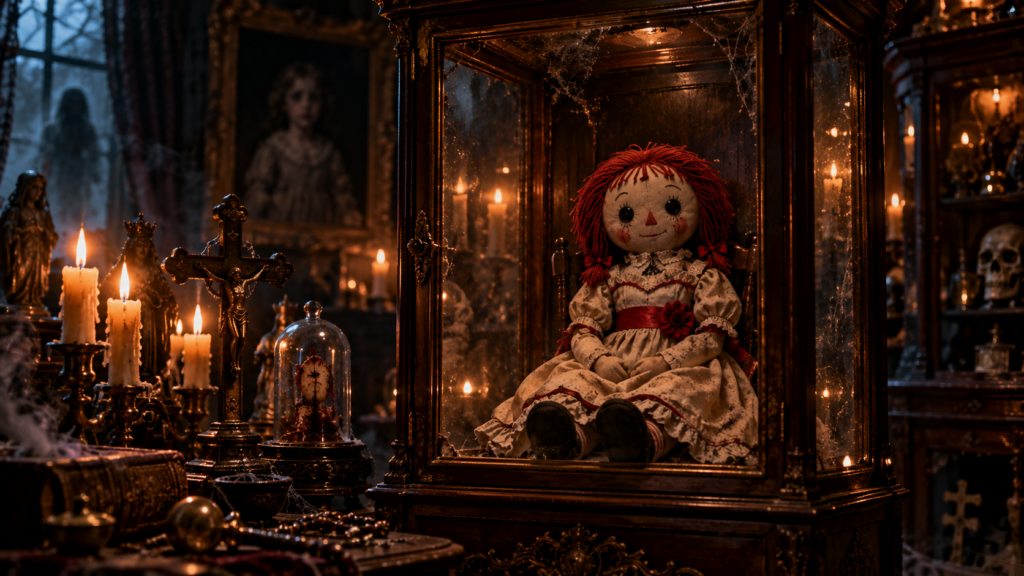
Anyone familiar with The Conjuring universe probably recognizes Annabelle as a disturbing porcelain doll with an expression that practically screams bad intentions. The real object behind the movies, however, looks remarkably different. The original Annabelle is a soft Raggedy Ann doll with red yarn hair, a cheerful smile, and a colorful dress. She looks like the kind of toy someone might lovingly place on a child’s bed, which arguably makes her alleged history even more unsettling.
The story dates to 1970, when a nursing student named Donna reportedly received the doll as a birthday present from her mother. According to the account later promoted by paranormal investigators Ed and Lorraine Warren, Donna and her roommate began noticing that Annabelle appeared in different positions and locations around their apartment. Strange handwritten messages supposedly appeared, and the women became increasingly frightened. After consulting a medium, they were reportedly told that the spirit of a young girl named Annabelle Higgins was associated with the doll.
The Warrens offered a much darker interpretation. They believed that the activity was not caused by the spirit of a child but by a malicious supernatural entity manipulating the toy. Annabelle was eventually placed inside a protective display case at their occult museum in Connecticut, becoming one of the most recognizable objects associated with their investigations. The supernatural claims remain unverified, and critics have questioned the reliability of the story. Nevertheless, Annabelle became a cultural phenomenon, inspiring films, documentaries, and generations of horror fans who will never look at a smiling rag doll quite the same way again.
The Hope Diamond: A Beautiful Jewel With an Ugly Reputation
Not every supposedly cursed object hides in a dark attic. Some are displayed under bright museum lights, admired by thousands of visitors, and valued at extraordinary sums. The Hope Diamond, a magnificent deep-blue gemstone weighing 45.52 carats, is one of the world’s most famous jewels. Its documented history stretches back to the seventeenth century, when a much larger blue diamond from India was acquired by French merchant Jean-Baptiste Tavernier and eventually sold to King Louis XIV.
Over the centuries, the stone passed through royal collections, disappeared during the French Revolution, and resurfaced in a different form. As its list of owners grew, stories began connecting the diamond with financial ruin, broken relationships, personal tragedies, and premature deaths. Some versions of the legend even claimed that the gemstone had originally been stolen from a sacred religious statue, provoking a curse against everyone who possessed it. That dramatic origin story, however, has no credible historical foundation.
The Smithsonian Institution, which received the diamond in 1958, explains that the curse became especially popular during the early twentieth century. Jeweler Pierre Cartier helped promote the frightening reputation while attempting to sell the stone to wealthy American socialite Evalyn Walsh McLean. The strategy worked rather well for a supposedly dangerous product. The diamond’s supposed victims were largely selected from a much longer history, while owners who experienced ordinary, uneventful lives rarely made the headlines. Today, the Hope Diamond remains a fascinating example of how a brilliant gemstone can become even more valuable when its story is wrapped in darkness.
The Myrtles Plantation Mirror: Reflections That Refuse to Disappear
Mirrors have always occupied a strange position in supernatural folklore. They show us a familiar world, but reversed, creating the unsettling impression that another reality exists just beyond the glass. In many traditions, mirrors were covered after a death because people feared that a departing soul might become trapped inside a reflection. That belief plays a central role in the legend surrounding an antique mirror at the Myrtles Plantation in St. Francisville, Louisiana.
The historic property has accumulated numerous ghost stories, but one of its best-known concerns the family of Sara Woodruff. According to local folklore, a mirror inside the house was accidentally left uncovered following deaths in the household, allowing the spirits of Sara and her children to become trapped within it. Over time, visitors began describing mysterious handprints, unexplained marks, and shadowy figures appearing in the glass. Some claimed the strange impressions returned even after attempts to clean the surface, making the mirror seem like a permanent reminder of the people who once lived there.
The actual historical record is considerably different from the more dramatic versions of the haunting. The Woodruff family suffered real losses to yellow fever, while popular tales involving poisoning and other supernatural details are not supported by reliable documentation. Yet the mirror continues to feature prominently in the property’s folklore. Perhaps its most disturbing quality is its familiarity. Unlike a strange wooden box or a century-old doll, nearly everyone owns a mirror. And when you glance into one late at night, there is always that fleeting possibility that something in the background might look different.
The Crying Boy: The Painting That Allegedly Survived Every Fire
During the 1980s, a disturbing story spread across Britain concerning an apparently harmless painting of a crying child. Reproductions of The Crying Boy, an image associated with artist Giovanni Bragolin, were common household decorations. The portrait showed a young child with tears running down his cheeks, creating an emotional scene that thousands of people displayed in their homes. But in 1985, newspaper reports began linking copies of the picture to house fires.
The legend suggested that homes containing the painting were unusually vulnerable to flames. Even more frightening was the claim that the buildings and their contents could be badly damaged while the portrait itself survived. As additional stories circulated, people began wondering whether the tearful child carried some supernatural connection to tragedy. The British tabloid The Sun helped fuel public concern, and frightened owners began removing the prints from their walls. The panic eventually became so intense that a public burning of copies was organized around Halloween.
There was, however, a far less supernatural explanation. The prints were extremely popular, making their presence in some homes affected by fires statistically unsurprising. Their materials also helped explain why certain copies survived. Investigations pointed toward the relatively fire-resistant backing used for some reproductions rather than any mysterious protection. Still, the legend demonstrated how quickly an ordinary decoration could become an object of national anxiety. The painting did not have to cause a fire to frighten people. Once the story became famous, simply owning it was enough.
The Hands Resist Him: The Haunted Painting That Terrified the Internet
Long before viral horror videos and supernatural TikTok challenges, one unusual painting managed to frighten thousands of internet users through an online auction. Created by American artist Bill Stoneham in 1972, The Hands Resist Him depicts a young boy standing beside a doll-like girl in front of a glass door. Behind the glass, numerous small hands appear to press outward from the darkness. Even without knowing its history, the image is unsettling. The characters seem strangely disconnected from their surroundings, while the hands suggest that something is trying to cross an invisible boundary.
In 2000, the painting appeared for sale on eBay with an extraordinary description. The sellers alleged that the figures moved during the night and sometimes appeared to leave the artwork entirely. Photographs included with the listing supposedly showed the characters behaving in disturbing ways. The story spread rapidly across the internet, with some viewers even claiming that looking at the painting’s digital image caused discomfort, nightmares, or strange sensations.
The artist himself offered a different interpretation. Stoneham explained that the boy was inspired by a childhood photograph, the girl represented a guide between imagined worlds, and the hands symbolized other lives or possibilities. His original intention was artistic rather than supernatural, and he has encouraged people to approach the haunting legend skeptically. Nevertheless, the painting became an early example of internet horror folklore, proving that a cursed object no longer needed to enter your home physically. A photograph on a computer screen could apparently do the job just as effectively.
The Busby Stoop Chair: A Seat Nobody Wants to Take
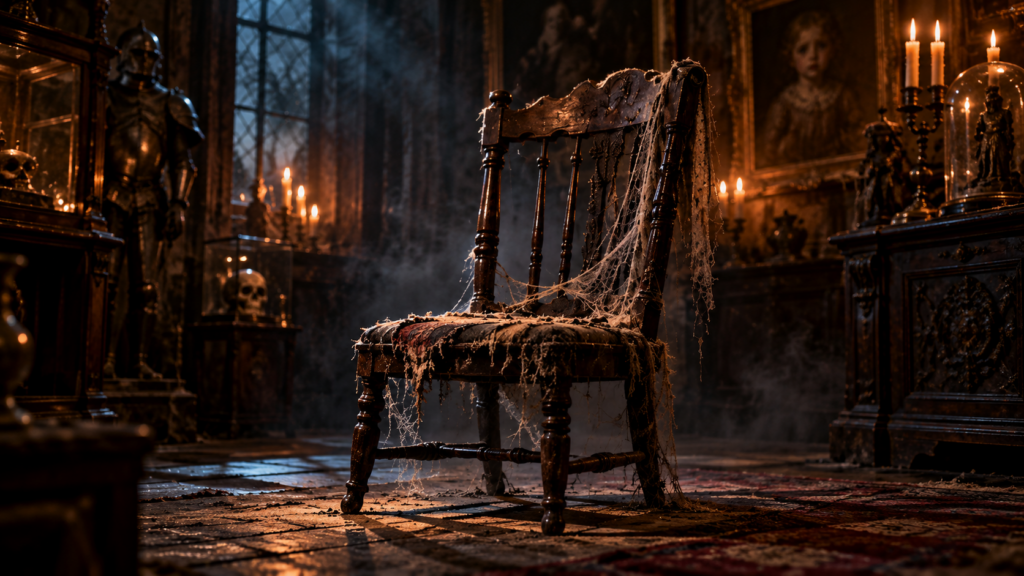
Most people worry about whether a chair is comfortable, sturdy, or attractive enough for their living room. In the English town of Thirsk, however, a particular wooden chair became famous for a much more alarming reason: the belief that anyone who sat in it might die. Known as the Busby Stoop Chair, or the Dead Man’s Chair, it became associated with Thomas Busby, a man executed for murder in 1702.
According to the traditional story, Busby became involved in a violent dispute with his father-in-law, Daniel Auty, and ultimately killed him. Before his execution, Busby supposedly placed a curse on the chair, declaring that anyone who sat in it would meet a terrible fate. Over the following centuries, local stories began linking the seat to unexplained deaths, fatal accidents, and wartime tragedies. Some accounts claimed that soldiers who sat in the chair before leaving for military service never returned.
Eventually, the chair was transferred to Thirsk Museum, where it was displayed out of reach rather than made available for visitors to try. Historical questions surround the legend, including whether the surviving chair could even date back to Busby’s lifetime. The deaths attributed to it are also based largely on anecdotes rather than verified supernatural connections. But there is something especially memorable about a cursed chair. Most legendary objects supposedly attack, follow, or frighten their owners. This one asks only that someone sit down. It’s difficult to imagine a more unfortunate way to discover that you chose the wrong seat.
The Dybbuk Box: The Curse That Escaped Into the Real World
Among modern cursed-object legends, few are as revealing as the story of the Dybbuk Box. The object became famous in 2003, when an antique wooden cabinet appeared in an eBay listing accompanied by an unsettling account of its past. The seller, Kevin Mannis, claimed the cabinet had belonged to a Holocaust survivor and was associated with a hostile spirit. The listing described nightmares, disturbing odors, strange experiences, and a series of unfortunate events allegedly connected to the box.
The name referred to the dybbuk, a spirit associated with Jewish folklore, although the idea of a spirit being sealed inside a special wine cabinet was not an established traditional practice. The story captured the public imagination, and later owners contributed additional accounts of unusual experiences. Eventually, the legend inspired the 2012 horror film The Possession, helping transform a relatively ordinary piece of furniture into one of the internet’s most recognizable haunted artifacts.
Then came an unexpected revelation. In a 2021 interview, Mannis admitted that he had created the original supernatural backstory as a work of fiction. He described the project as an interactive horror story that had grown far beyond its original online auction. Despite that confession, some believers continued to attribute mysterious powers to the object. The Dybbuk Box offers an unusual lesson: sometimes a curse does not need centuries of ancient history, a supernatural encounter, or an unexplained death. All it needs is a compelling story and enough people willing to believe it.
Why Do We Believe Objects Can Be Cursed?
The most fascinating part of these stories might not be the objects themselves, but the reactions they inspire. Human beings are naturally drawn to patterns, especially when something frightening or unexpected happens. If someone buys an antique mirror and experiences a series of nightmares, the mirror suddenly seems suspicious. If a person photographs a reportedly haunted doll and gets into an argument the next day, an ordinary disagreement can begin to feel like evidence of a curse. Once an object develops a reputation, even completely unrelated events may appear connected to it.
Psychologists sometimes describe part of this process as confirmation bias: our tendency to notice information that supports our expectations while overlooking information that contradicts them. A person who believes an object brings bad luck may remember every broken glass, missed appointment, and unfortunate coincidence while forgetting the many uneventful days between them. Stories also become more dramatic as they are retold, particularly when newspapers, films, and social media reward the most frightening version.
Yet cursed-object legends also reveal something meaningful about the way we experience history. Objects survive their owners, passing between families, countries, and generations while accumulating stories along the way. A doll can become associated with someone’s childhood. A mirror can remind people of a family tragedy. A gemstone can symbolize the rise and fall of powerful dynasties. We attach emotions to possessions because they represent the people, memories, and mysteries that came before us. Sometimes those emotions are comforting. Sometimes they are terrifying.
Final Thoughts: Would You Bring a Cursed Object Home?
From Annabelle’s innocent smile to the Hope Diamond’s brilliant blue glow, supposedly cursed objects have become some of the most enduring characters in supernatural folklore. Their stories have inspired films, museum exhibitions, ghost tours, internet mysteries, and countless late-night conversations. While there is no convincing evidence that any of these items possess supernatural abilities, their influence on human imagination is undeniable.
Perhaps the greatest power of a cursed object is not the ability to move across a room, cause misfortune, or trap a wandering spirit. Perhaps it is the ability to make someone question an ordinary moment. A floorboard creaks. A picture frame falls. A door opens unexpectedly. Events that would normally be dismissed suddenly seem connected to something mysterious.
And that leads to one final question. Imagine discovering a beautiful antique object at a secondhand shop, only to learn that every previous owner believed it was cursed. Would you take it home and trust that the stories were nothing more than superstition?
Or would you leave it exactly where you found it?
After all, some stories are much more enjoyable when they belong to someone else’s possessions.
And speaking of mysterious surprises, why not keep the Halloween excitement going at Eternal Slots? Explore our collection of thrilling slot games, embrace the spooky atmosphere, and see what surprises the reels have waiting for you. Unlike a cursed antique, your next spin doesn’t come with a century-old ghost story, although luck is never guaranteed!
Still craving more Halloween mysteries? Don’t miss our blog, How Halloween Became a Billion-Dollar Industry, where we explore how a holiday once associated with ancient traditions, wandering spirits, and supernatural fears transformed into a massive global business filled with costumes, candy, decorations, and entertainment.
Because Halloween isn’t just about what goes bump in the night. Sometimes, the real mystery is how much money we spend celebrating it!

You might also like










Leave A Reply