
Why do we willingly watch terrifying movies, explore haunted houses, and surround ourselves with frightening decorations every October? The answer lies in the fascinating relationship between fear, pleasure, curiosity, and the human brain.
Imagine this.
It’s 2:13 AM. You’re lying in bed after watching a horror movie. The house is completely silent, except for the occasional sound of the wind outside.
Suddenly, you hear footsteps.
Your heart starts racing. You stop breathing for a second. Your eyes immediately turn toward the bedroom door.
You know you’re home alone.
Or at least, you thought you were.
A few seconds later, you realize the mysterious noise was probably just the heating system.
But here’s the strange part.
Tomorrow night, you’ll probably watch another horror movie.
Why do human beings intentionally seek out experiences that terrify them?
Every Halloween, millions of people willingly pay to enter haunted houses, watch frightening films, dress as monsters, and tell ghost stories in the dark.
In almost every other situation, fear is something we try to avoid. Yet during Halloween, we celebrate it.
Psychologists have spent years trying to understand this unusual contradiction.
And what they’ve discovered suggests that our fascination with fear reveals something remarkable about the way the human mind works.
1. The Strange Pleasure of Being Terrified
- 1. The Strange Pleasure of Being Terrified
- 2. What Actually Happens Inside Your Brain When You're Scared?
- 3. Why Horror Movies Feel So Addictive
- 4. The Mystery of Haunted Houses: Why Certain Places Feel Evil
- 5. Why We Love Ghost Stories Even When We Don't Believe in Ghosts
- 11. The Final Mystery: Are We Really Afraid of Monsters or Ourselves?
- Final Thoughts: Maybe We Don't Love Fear. Maybe We Love Surviving It.
Think about the last time something genuinely frightened you.
Perhaps someone unexpectedly jumped out from behind a door. Maybe you heard a strange noise in an empty building or watched a horror movie so disturbing that you couldn’t sleep afterward.
Your body probably reacted immediately.
Your heartbeat accelerated. Your muscles tightened. Your attention narrowed.
These are ordinary defensive reactions designed to help you respond to potential danger.
So why can those same sensations feel exciting when you’re inside a haunted attraction?
The answer involves a psychological phenomenon known as recreational fear.
Recreational fear occurs when people voluntarily experience frightening situations primarily for entertainment.
Unlike actual danger, recreational fear usually happens in an environment where we understand that the threat is fictional, controlled, or temporary.
A monster chasing you through a haunted attraction can be exhilarating because part of your brain recognizes the danger while another part understands that you’re participating in an experience designed to frighten you.
Researchers at Aarhus University explored this phenomenon in a fascinating 2020 study published in Psychological Science.
They equipped 110 visitors to a haunted-house attraction with heart-rate monitors and recorded their reactions during frightening encounters.
Their findings revealed something unexpected.
The relationship between fear and enjoyment resembled an upside-down U.
Visitors tended to enjoy themselves most when the fear was neither too weak nor too overwhelming.
Too little fear felt boring.
Too much fear could become unpleasant.
But the right amount created an exciting experience.
This helps explain why one person might enjoy a creepy ghost story while another prefers an extreme haunted-house experience.
We aren’t necessarily searching for the greatest possible terror.
We’re searching for the amount of fear that feels exciting to us.
And sometimes, discovering that limit becomes part of the entertainment.
2. What Actually Happens Inside Your Brain When You’re Scared?
Your brain doesn’t need to see an actual monster to initiate a fear response.
Sometimes, the possibility of danger is enough.
When you encounter something frightening, several interconnected brain systems begin processing the situation.
One important structure is the amygdala, which helps detect emotionally significant information, including potential threats.
Other areas, including the hypothalamus and brainstem, coordinate physical responses that prepare your body to react.
Your sympathetic nervous system may become more active.
As a result, you might experience:
- A faster heartbeat
- Quicker breathing
- Sweaty palms
- Increased muscle tension
- Heightened attention
- A sudden urge to freeze, escape, or defend yourself
Hormones such as adrenaline help support the body’s response to perceived danger.
These reactions evolved because detecting danger quickly can be more important than understanding every detail of a situation.
Imagine our ancestors hearing movement in the bushes.
Was it the wind?
A harmless animal?
Or a predator?
Waiting for perfect information could have been dangerous.
Our brains are therefore equipped to respond to uncertain threats, sometimes before we have consciously identified what caused them.
This same system can become active when watching a terrifying movie.
Even though you intellectually understand that the creature on screen isn’t real, your emotional and physiological responses can still be genuine.
The difference is context.
While your body reacts to the frightening scene, your awareness of being safe allows you to interpret some of that arousal as excitement.
A horror movie can make your body feel threatened without placing you in the danger being depicted.
That contradiction is one of the foundations of recreational fear.
3. Why Horror Movies Feel So Addictive
Have you ever watched a horror movie while telling yourself that you absolutely would not look at the screen during the next frightening scene?
Then, when that moment arrived, you looked anyway.
This is one of the most interesting contradictions in horror entertainment.
We want to avoid the frightening image.
But we also desperately want to know what’s going to happen.
Horror filmmakers understand this conflict.
They rarely rely on frightening images alone.
Instead, they manipulate anticipation.
A character enters an abandoned house.
The camera slowly moves toward a dark hallway.
The music disappears.
A door begins opening.
Nothing happens.
And somehow, that silence becomes more terrifying than the monster itself.
Our brains continually generate expectations about what might happen next.
When information is incomplete, uncertainty keeps us mentally engaged.
Horror movies exploit this by delaying answers.
We start searching for clues, imagining threats, and predicting possible outcomes.
Sometimes, our imagination produces something more disturbing than anything the filmmaker could show.
There’s also a powerful emotional rhythm involved.
Suspense builds.
Fear intensifies.
The threat appears.
Then the immediate tension breaks.
That cycle of anticipation, fright, and relief can make the viewing experience compelling.
The relief matters because it reminds us that the frightening event has passed.
For people who enjoy horror, the emotional contrast can be part of the pleasure.
However, horror isn’t universally enjoyable.
For some viewers, frightening films cause lingering anxiety, distress, or nightmares.
What feels thrilling to one person can feel overwhelming to another.
And that difference leads to another question.
Why are some people drawn to darkness while others avoid it completely?
4. The Mystery of Haunted Houses: Why Certain Places Feel Evil
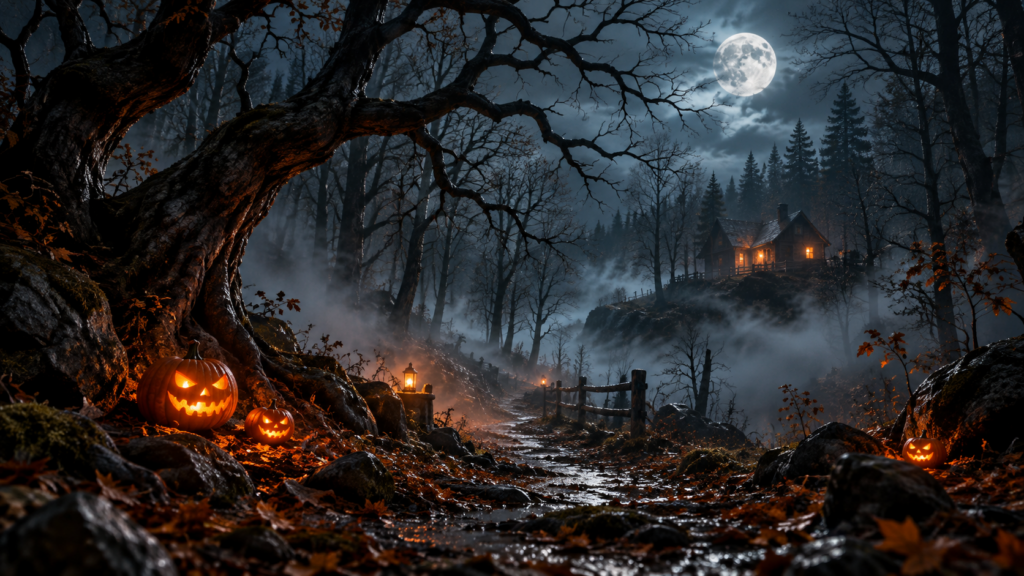
Picture two houses.
The first is bright, modern, and filled with people.
The second is abandoned, with broken windows, peeling wallpaper, dark corridors, and an old wooden staircase.
Which one feels more frightening?
Most people would immediately identify the abandoned house.
But why?
The building itself might pose no supernatural threat.
Yet its appearance can trigger powerful emotional reactions.
Part of the explanation involves uncertainty.
When visibility is limited, our brains receive less information about the surrounding environment.
Dark corners conceal details.
Unfamiliar sounds become difficult to identify.
Unexpected movement feels more significant.
Our minds attempt to fill those gaps.
A hanging coat becomes a human figure.
The sound of expanding wood becomes a mysterious footstep.
A reflection in a dark window resembles someone watching from outside.
Psychologists use the term pareidolia to describe situations in which people perceive meaningful patterns, such as faces, in ambiguous stimuli.
This helps explain why people sometimes see faces in shadows, clouds, or old photographs.
There’s also the feeling of creepiness itself.
In a 2016 study published in New Ideas in Psychology, researchers Francis McAndrew and Sara Koehnke examined what makes people perceive something as creepy.
Their research emphasized the importance of unpredictability and uncertainty, particularly when evaluating potentially threatening people.
Although the study focused on perceived creepiness rather than haunted buildings, a similar principle helps explain why unsettling environments capture our attention.
The most frightening situation is often one where we cannot decide whether something is dangerous.
A visible monster gives us a threat to identify.
An unexplained sound in an empty hallway gives us a mystery.
And sometimes, mystery is worse.
5. Why We Love Ghost Stories Even When We Don’t Believe in Ghosts
Imagine sitting around a campfire with several friends.
Someone begins telling a story about an abandoned hotel where guests supposedly hear a woman crying every night.
You don’t believe in ghosts.
You know the story might be invented.
But when the storyteller describes hearing footsteps approaching an empty room, you instinctively look over your shoulder.
Why?
Because emotional engagement doesn’t require complete belief.
Human beings can become deeply involved in fictional experiences even while understanding that they are imaginary.
We cry during movies even though the characters aren’t real.
We become angry when fictional villains betray someone.
We feel nervous when a detective enters a dangerous room.
Ghost stories work in a similar way.
But they also explore subjects that human beings have struggled to understand for thousands of years.
Death.
Loss.
The unknown.
The possibility that something exists beyond ordinary human perception.
Ghost stories frequently transform these abstract fears into something concrete.
A mysterious figure standing at the end of a hallway is easier to imagine than the uncertainty surrounding death itself.
Many supernatural stories also feature familiar places.
Homes, hospitals, schools, and hotels become frightening when something supposedly impossible happens inside them.
This contrast is important.
A monster in a fantasy world might feel distant.
A strange voice coming from your own bedroom feels personal.
And perhaps that’s why ghost stories remain so compelling.
They suggest that the ordinary world might contain mysteries we haven’t yet explained.
There is no convincing scientific evidence that ghosts cause the experiences attributed to them, but that uncertainty within a good fictional story can still produce genuine fear.
11. The Final Mystery: Are We Really Afraid of Monsters or Ourselves?
Let’s return to the abandoned house.
Imagine standing outside at midnight.
The windows are dark.
The front door is slightly open.
You hear a mysterious noise coming from upstairs.
What frightens you most?
Is it the possibility that a monster is hiding inside?
Or is it the fact that you don’t know what’s waiting beyond the doorway?
Perhaps the real power of horror comes from its ability to transform familiar human fears into extraordinary stories.
Vampires explore the relationship between mortality and immortality.
Ghosts reflect questions about death, memory, and unfinished relationships.
Zombies can represent fears of disease, social collapse, or losing control.
Possession stories challenge our sense of personal identity.
Masked killers make us confront the frightening possibility that danger can hide behind an ordinary human appearance.
These interpretations aren’t universal rules, and different stories carry different meanings.
But they demonstrate something important about horror.
A frightening story doesn’t need to be realistic to reflect something emotionally recognizable.
The supernatural monster might be imaginary, but the human fear behind it is real.
And perhaps that’s why Halloween has remained such a compelling celebration.
For one night, we invite darkness into our homes.
We decorate ordinary spaces with symbols of danger and death.
We transform ourselves into creatures that would terrify us in real life.
And instead of running away from fear, we turn it into entertainment.
Halloween allows us to explore the things we usually avoid, surrounded by the reassurance that the frightening experience will eventually end.
We get to open the mysterious door.
We get to enter the haunted house.
We get to confront the monster.
And afterward, we get to close the door and return to ordinary life.
Final Thoughts: Maybe We Don’t Love Fear. Maybe We Love Surviving It.
Next time you watch a horror movie, visit a haunted attraction, or listen to a ghost story, pay attention to what happens when the frightening moment ends.
Your breathing slows.
Your muscles relax.
You laugh at the scream you just made.
The terrifying scene becomes something you can remember, describe, and share.
For a moment, something felt genuinely dangerous.
But you made it through.
Perhaps that’s one of the reasons people return to frightening entertainment year after year.
Not because we want to experience real danger.
Not because we’re secretly fascinated by suffering.
But because controlled fear allows us to experience a powerful emotional journey while knowing that we can eventually return to safety.
Of course, the experience isn’t the same for everyone.
For some people, the best Halloween involves terrifying movies and haunted houses.
For others, it’s a cozy evening filled with pumpkins, candy, and harmless supernatural stories.
Both are perfectly valid ways to enjoy the holiday.
But there’s one final question worth considering.
If you were completely alone tonight, and you heard three slow knocks coming from inside your bedroom closet… would you open it?
Or would you spend the rest of the night wondering what was behind the door?
Keep the Halloween Thrills Going with Eternal Slots!
The spooky season doesn’t have to end when the horror movie credits roll.
If you’re looking for a little more Halloween entertainment, explore the world of online slots at Eternal Slots, where mysterious themes, exciting game features, and atmospheric adventures offer a different kind of thrill. Remember to play responsibly and keep the experience fun.
And if you think modern Halloween celebrations are strange, you haven’t heard the half of it!
Discover bizarre ancient rituals, mysterious superstitions, and surprising customs in our fascinating article: Halloween Traditions That Are Stranger Than Fiction.
From eerie traditions to forgotten legends, you’ll discover that Halloween’s real history can be just as fascinating as its fictional monsters.
Happy Halloween! And remember: sometimes, what we imagine is far more frightening than what is actually there.
Stay curious, stay spooky, and enjoy the Halloween season with Eternal Slots!



Leave A Reply