
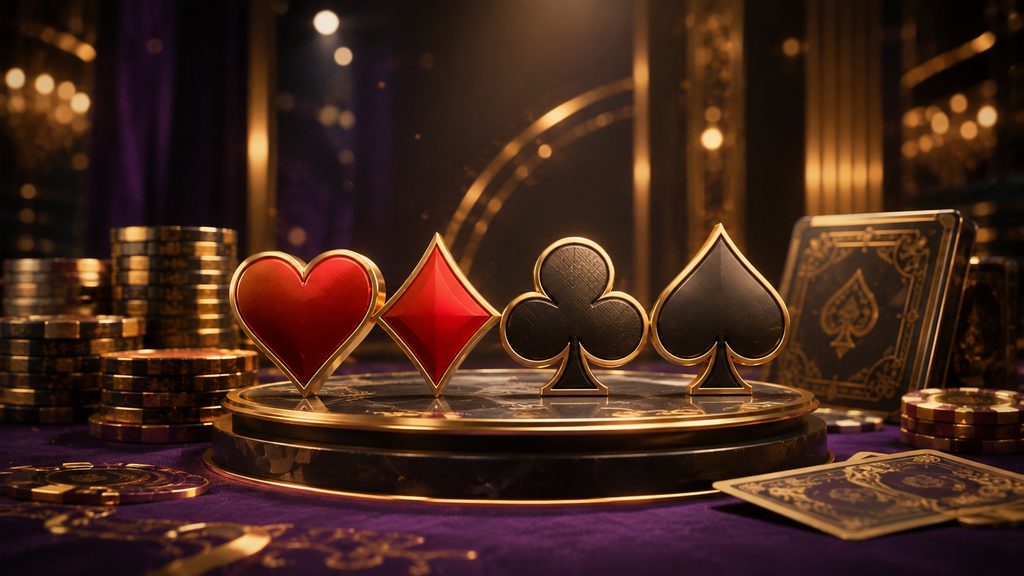
Playing card suits are so familiar that most of us barely stop to think about them. Hearts, diamonds, clubs, and spades appear on everything from poker tables to online card games, but these four simple symbols have a surprisingly long history behind them.
They were not always the universal standard. Different countries once used very different card suit symbols, and the four designs we recognize today developed gradually as playing cards traveled across cultures and became easier to print and reproduce.
So where did hearts, diamonds, clubs, and spades come from, and do they actually mean anything?
Where Did Playing Card Suits Come From?
- Where Did Playing Card Suits Come From?
- What Do the Four Playing Card Suits Mean?
- Why Are There Four Suits in a Deck of Cards?
- Why Are Hearts Red but Clubs Black?
- Are Playing Card Suits the Same Everywhere?
- How Playing Card Suits Became Part of Casino Culture
- Which Playing Card Suit Is the Most Powerful?
- Four Simple Symbols With Centuries of History
- This Week’s Exclusive Spin Club Checkpoint
The history of playing card suits is closely connected to the history of playing cards themselves.
Playing cards are believed to have originated in Asia before eventually reaching Europe during the Middle Ages. Early European decks did not all look the same. Depending on the region, players could find suits represented by cups, coins, swords, bells, leaves, acorns, and other objects.
By the late 15th century, French card makers had developed the four suit symbols that would eventually become internationally recognizable:
- Hearts
- Diamonds
- Clubs
- Spades
These designs had one major advantage: they were simple.
Compared with highly detailed illustrations, basic shapes were easier and cheaper to reproduce using early printing techniques. As French playing cards spread to other countries, their symbols gradually became the standard used in many modern decks.
Today, a standard 52-card deck still follows that familiar structure.
What Do the Four Playing Card Suits Mean?
You may have seen claims that the four suits represent different social classes, seasons, elements, or areas of medieval life.
Those interpretations are interesting, but there is no single universally accepted historical meaning behind all four suits.
Still, over time, each symbol has developed strong cultural associations of its own.
Hearts
The heart is probably the easiest suit to interpret today.
It naturally brings to mind love, emotion, romance, and relationships. In older French decks, the symbol was known as cœur, meaning heart.
Because of its familiar shape and emotional association, hearts have also become one of the most recognizable playing card suit symbols outside card games.
Diamonds
Diamonds are often connected with wealth, value, luxury, and material success.
The French name for this suit, carreau, originally referred to a tile or square shape rather than the gemstone itself. In English, however, the shape eventually became associated with diamonds.
That later interpretation gave the suit the glamorous meaning many people recognize today.
Clubs
The club symbol looks more like a three-leaf clover than a weapon.
That makes more sense when you look at its French name: trèfle, meaning clover.
English-speaking players eventually called the suit “clubs,” probably connecting it with earlier suit traditions involving batons or clubs.
So while we call it a club, its visual origin is actually much closer to a clover.
Spades
Spades may be the most mysterious-looking of the four suits.
The French name pique refers to a pike or pointed weapon. The English name “spade” came from a different interpretation of the shape, which resembles the head of a digging tool.
Over time, the spade became especially iconic, partly because the Ace of Spades often receives special treatment in card design and popular culture.
Why Are There Four Suits in a Deck of Cards?
The familiar four playing card suits divide a standard deck into four equal groups of 13 cards.
Each suit contains:
Ace, 2 through 10, Jack, Queen, and King.
Together, that creates the classic 52-card deck.
There are many theories connecting these numbers to the calendar, for example, four suits representing four seasons or 52 cards representing 52 weeks of the year.
These ideas are fun and have become popular pieces of card folklore, but historians generally treat them as later interpretations rather than confirmed reasons the deck was created that way.
Sometimes a deck is simply a deck.
And sometimes people are very good at finding patterns after the fact.
Why Are Hearts Red but Clubs Black?
Modern decks usually use two colors:
Red: hearts and diamonds
Black: clubs and spades
This two-color system makes cards easier to read quickly.
Historically, however, playing cards were not always limited to red and black. Some decks used several colors, and modern four-color decks still exist today, particularly for games where distinguishing suits quickly can be useful.
The familiar red-and-black design became popular largely because it was practical and easy to print.
Simple design won again.
Are Playing Card Suits the Same Everywhere?
Not completely.
Hearts, diamonds, clubs, and spades dominate international card culture today, but regional decks still use traditional symbols.
German-suited cards, for example, may feature hearts, bells, acorns, and leaves. Spanish and Italian traditions often use variations of cups, coins, swords, and clubs.
This makes the origin of playing card suits even more interesting.
The symbols we now see as completely normal are really just one branch of a much larger family of card traditions.
How Playing Card Suits Became Part of Casino Culture
Once card games became closely associated with casinos, the four suits became part of casino visual language too.
You can spot hearts, diamonds, clubs, and spades on tables, signs, game interfaces, slot symbols, casino chips, and promotional artwork.
Even games that are not traditional card games often use playing card imagery because players instantly recognize it.
At Eternal Slots Casino, you may come across familiar card symbols alongside classic 7s, lucky numbers, coins, and other casino icons across different game themes.
If you want to understand more of the language that appears across casino games, our guide to slot terms every player should know is another useful place to start.
Which Playing Card Suit Is the Most Powerful?
In a standard deck, no suit is naturally more powerful than another.
The ranking depends entirely on the rules of the game being played.
Some card games assign an order to suits. Others treat them as completely equal.
The Ace of Spades may look dramatic, and the heart may be the most emotionally recognizable symbol, but neither has universal mathematical power.
Like many casino traditions, the symbolism is often much more interesting than the probability.
Four Simple Symbols With Centuries of History
The next time you see hearts, diamonds, clubs, and spades, they may look slightly different.
What seems like a simple set of card suit symbols is actually the result of centuries of travel, cultural influence, design changes, and printing innovation.
Different countries created their own versions. Some symbols disappeared. Others survived.
And four of them eventually became recognizable almost everywhere.
Not bad for a few tiny shapes on a deck of cards.
This Week’s Exclusive Spin Club Checkpoint
Speaking of familiar casino symbols, there is another one worth looking for this week: the Exclusive Spin Club badge.
Eligible members can collect 25 Free Spins through this week’s checkpoint.
Here is what to do:
- Make one qualifying deposit of at least $20 to activate your Spin Club pass.
- Your pass gives you access to four weekly checkpoints.
- Visit the latest Eternal Slots blog post each week.
- Find the hidden weekly code.
- Enter the code at Eternal Slots.
- Collect your 25 Free Spins.
- Return next week for another checkpoint.
Complete all four weekly checkpoints and you can collect up to 100 Free Spins during the four-week period.
This week’s hidden code: ESC-KPM6HX9YKD4
Weekly Free Spins terms: 25 Free Spins; 15× wagering on Free Spins winnings; maximum cash-out $50; maximum bet $5; slots only; one redemption per player.
Four suits. Four weekly checkpoints. And one more reason to come back next week.
Play responsibly. Casino symbols may have fascinating stories, but they cannot influence random game results.

You might also like










Leave A Reply