
Travel used to be about seeing as much as possible. Five cities in seven days, three museums before lunch, a famous viewpoint at sunset, dinner at the restaurant everyone recommends, and then an early train the next morning because there is still another destination waiting. It sounds exciting, and sometimes it is, but somewhere between airport security, hotel check-ins, Google Maps, crowded attractions, and trying to fit twenty experiences into one weekend, travel can start feeling suspiciously like work.
That is exactly why more travelers are becoming interested in a different approach: slow travel. Slow travel is not about spending three months in a tiny village with no Wi-Fi. It does not mean avoiding famous landmarks, refusing to make plans, or traveling without an itinerary. It simply means giving yourself enough time to actually experience a place instead of racing through it.
Surprisingly, doing less can often make a trip feel much bigger.
What Is Slow Travel?
- What Is Slow Travel?
- The Problem With Trying to See Everything
- Slow Travel Allows Places to Surprise You
- Stay Longer in Fewer Places
- Explore Neighborhoods, Not Just Attractions
- Eat Where You Are
- Leave Empty Space in Your Itinerary
- Travel by Train When It Makes Sense
- Slow Mornings Can Change an Entire Vacation
- You Do Not Need to Photograph Everything
- Spend Time in Local Markets
- Return to the Same Place Twice
- Slow Travel Can Also Be Cheaper
- You Notice More When You Stop Rushing
- Slow Travel Does Not Mean Doing Nothing
- Try Living Like a Local Without Pretending You Are One
- Choose Experiences You Actually Enjoy
- Take Day Trips Instead of Constantly Changing Hotels
- Learn Something About the Destination Before You Arrive
- Stop Measuring Trips by How Much You Saw
- How to Plan Your First Slow Travel Trip
- Final Thoughts
Slow travel is a style of traveling that focuses on quality rather than quantity. Instead of asking, “How many places can I visit?” you start asking, “How well can I experience this place?” The idea is to stop treating every destination like a checklist and start paying more attention to how the place actually feels.
A traditional itinerary might involve Rome on Monday, Florence on Tuesday, Venice on Wednesday, and Milan on Thursday. By Friday, you are exhausted and barely remember which café belonged to which city. A slow travel itinerary might involve spending several days in Rome, exploring different neighborhoods, eating at local restaurants, visiting markets, and leaving enough free time for unexpected discoveries.
The goal is not necessarily to travel slowly in the literal sense. You can still take planes, visit popular attractions, and have a schedule. The difference is that your entire trip is not designed around checking things off a list.
The Problem With Trying to See Everything
There is a strange pressure that comes with traveling somewhere new. You may only visit Paris once, so obviously you feel like you need to see the Eiffel Tower, the Louvre, Montmartre, Versailles, Notre-Dame, the Arc de Triomphe, and perhaps take a Seine cruise as well. Then you remember the croissant place you saw on TikTok, and suddenly your relaxing Paris vacation has turned into a military operation.
The fear of missing out can completely change how we travel. Instead of enjoying the place we are currently standing in, we are already thinking about the next location. We take a photo, check the attraction off the list, open Google Maps, and move on.
The problem is that memory does not always work according to how many attractions you visited. Sometimes the things you remember most clearly are completely unplanned: the tiny café where it started raining, the street musician you stopped to listen to, a random bakery discovered while walking back to the hotel, or a conversation with someone sitting next to you. Those moments need something that extremely busy itineraries rarely provide: time.
Slow Travel Allows Places to Surprise You
Some of the best travel experiences happen because you were not looking for them. Imagine walking through a neighborhood in Barcelona with nowhere specific to be for the next two hours. You notice a small bookstore, then a bakery, then a quiet square filled with locals drinking coffee. None of these places appear on your carefully researched “Top 20 Things to Do in Barcelona” list, but suddenly you feel like you are experiencing the city rather than simply visiting it.
This is one of the biggest differences between traditional tourism and slow travel. Tourism often shows you the highlights, while slow travel gives you the details. Those details are usually what make one city feel completely different from another.
Stay Longer in Fewer Places
One of the easiest ways to experiment with slow travel is incredibly simple: visit fewer destinations. Instead of trying to squeeze three cities into a five-day trip, choose one. Instead of visiting four islands during a summer holiday, stay longer on two.
At first, you may feel like you are missing opportunities, but something interesting happens after spending a few days in the same place. On the first day, everything feels unfamiliar. On the second day, you begin recognizing streets. By the third day, you already know where you want to get coffee and which route you prefer walking back to your accommodation.
You stop looking at your map every five minutes, and the destination slowly becomes more comfortable. That feeling can completely change the way you experience a trip.
Explore Neighborhoods, Not Just Attractions
Every major destination has a list of landmarks people feel obligated to visit, and there is nothing wrong with seeing them. They are famous for a reason. However, a city is much more than its postcard attractions.
One of the easiest slow travel habits is dedicating time to simply exploring neighborhoods. Pick an area, walk around, stop when something looks interesting, sit somewhere for coffee, look inside small stores, visit a local market, or spend time in a park. You do not necessarily need a specific destination.
For travelers who are used to detailed schedules, this can initially feel strange. You may even wonder whether you are wasting time. You are not. Walking through ordinary streets can teach you more about the personality of a destination than another hour standing in line for an attraction.
Eat Where You Are
Food is one of the fastest ways to understand a destination, yet travelers often spend enormous amounts of time searching for “the best restaurant.” Sometimes that search is worth it, but sometimes you can simply look around.
Is there a restaurant full of locals? Is there a bakery with a queue in the morning? Is there a small family-run place you keep walking past? Try it. Slow travel encourages curiosity rather than constant optimization.
Not every meal needs to come from the highest-rated restaurant in the city. Some meals can simply be good food discovered at the right moment, and those are often the places you end up recommending years later.
Leave Empty Space in Your Itinerary
This might be the most difficult travel advice for people who love planning: do not plan everything. Create empty space in your itinerary and allow yourself to decide what to do once you are already there.
Maybe your morning has one activity, but you leave the afternoon open. Perhaps you have dinner reservations at 8 PM, but you do not automatically schedule three attractions before them. That empty space gives you options.
You might discover a beach and decide to stay longer. You might find a neighborhood you want to explore, feel tired and return to your hotel, or hear about an event happening later that evening. Flexibility is not wasted time. It is where spontaneous travel experiences happen.
Travel by Train When It Makes Sense
Flying is often unavoidable, especially for longer distances, but when destinations are relatively close, trains can completely change the journey. Airports usually separate you from the landscape, while trains allow you to see what exists between two cities.
You can watch towns, fields, mountains, and coastlines pass by the window while you travel. Trains also often bring you directly into city centers, which can save you from long airport transfers and complicated security procedures.
Perhaps most importantly, traveling by train gives your brain time to transition between places. Sometimes the journey itself becomes one of the nicest parts of the trip.
Slow Mornings Can Change an Entire Vacation
There is something deeply underrated about waking up somewhere new without an alarm. No bus tour at 7:15 AM, no attraction ticket at 8:00 AM, and no rushing through breakfast because you are already behind schedule.
Instead, you walk outside, find coffee, and watch the city wake up. Maybe you have one plan for later, or perhaps you have no plans at all. Travel often makes us believe that every hour needs to be productive, but you are allowed to have normal mornings on vacation.
In fact, those mornings can make an entire trip feel longer and more relaxing.
You Do Not Need to Photograph Everything
Photos are one of the best souvenirs we have. Years later, a single picture can instantly bring back memories of a destination, but there is a difference between photographing an experience and experiencing something primarily to photograph it.
Slow travel encourages you to sometimes put the phone away. Watch the sunset without recording the entire thing. Eat the dessert before taking twenty pictures of it. Walk through a beautiful street without immediately thinking about Instagram.
You can still take photographs, of course. Just remember that your camera does not need to experience the entire vacation for you.
Spend Time in Local Markets
If you want to understand everyday life in a destination, visit a market. Food markets, farmers’ markets, flea markets, flower markets, and even small neighborhood grocery stores can reveal a lot about a place.
Markets show you what people eat, what products are local, and how everyday life actually feels. They are also excellent places to discover things you were not specifically searching for, whether that is local cheese, fresh fruit, handmade products, street food, vintage objects, or a souvenir that does not look like it came from an airport gift shop.
Markets rarely require a complicated itinerary. You simply arrive and explore, which is exactly the point.
Return to the Same Place Twice
Travel culture often encourages novelty. We are constantly looking for a new restaurant, a new café, a new neighborhood, and a new attraction because every experience is supposed to be different.
However, there is something special about returning somewhere. Maybe you discover a café you love on your first morning, so you go back the next day. Perhaps the restaurant near your accommodation has incredible pasta, and you decide to eat there again. Maybe you found a quiet beach and want to return at sunset.
Repeating experiences creates familiarity. For a short period of time, you stop feeling like someone simply passing through and start developing small routines. Strangely enough, those routines often become some of the strongest memories from the trip.
Slow Travel Can Also Be Cheaper
Constant movement costs money. Flights, train tickets, taxis, airport transfers, baggage fees, and transportation between hotels and stations can quickly increase the total price of a trip.
When you stay longer in fewer places, many of those costs disappear. Longer accommodation stays may also offer better nightly rates, and after spending several days somewhere, you may naturally begin shopping at local supermarkets or discovering affordable cafés instead of eating every meal in expensive tourist areas.
Slow travel is not automatically cheap, but it can make budgeting significantly easier.
You Notice More When You Stop Rushing
There is a reason people sometimes return from fast-paced vacations feeling like everything happened in a blur. Your brain barely has time to process one destination before moving to another.
Slow travel gives memories space to form. You remember the route from your apartment to the center, the waiter who served you breakfast, the way the streets looked after rain, or the sound coming from the square outside your hotel.
These details may seem insignificant during the trip, but later they often become the trip.
Slow Travel Does Not Mean Doing Nothing
There is one important misconception about slow travel: it does not mean sitting in one café for twelve days. You can still explore, visit museums, take tours, go hiking, see famous landmarks, book experiences, and take day trips.
The difference is that those activities do not need to occupy every available minute. You could spend a morning at a museum and an afternoon walking through the city. You could take a day trip and keep the following morning free. You could visit the famous viewpoint without immediately rushing to six other landmarks afterward.
Slow travel is about balance, not inactivity.
Try Living Like a Local Without Pretending You Are One
Travelers often use the phrase “live like a local.” The idea is appealing, but the reality is obvious: if you are visiting Lisbon for six days, you are still a visitor, and that is completely fine.
A better goal might be to observe local life. Use public transportation, visit neighborhood restaurants, learn a few words of the language, respect local customs, shop at local businesses, and explore beyond the main tourist center.
Travel can become more meaningful when you are curious about how people actually live in the place you are visiting.
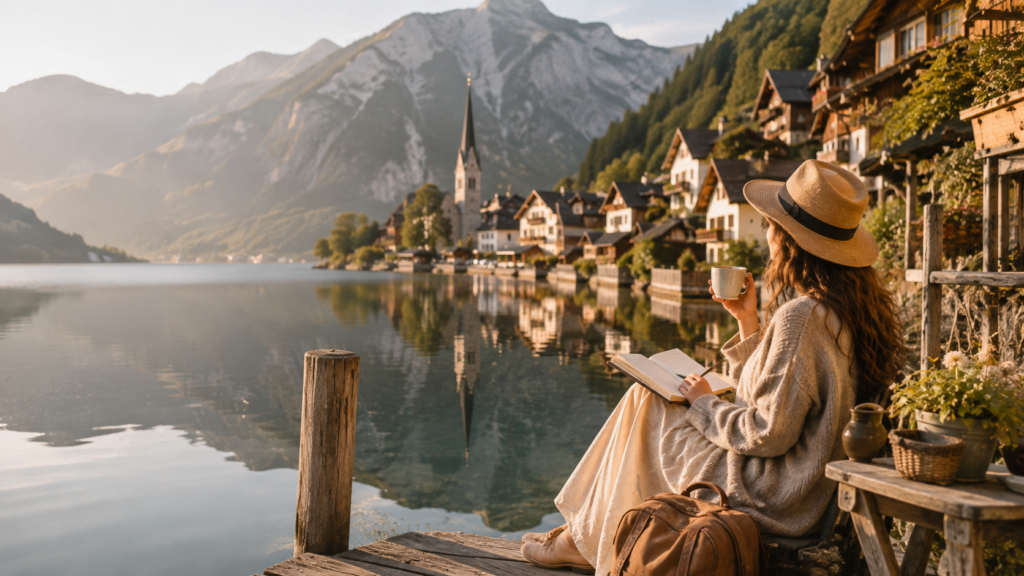
Choose Experiences You Actually Enjoy
One of the strangest things people do while traveling is participate in activities they do not even like. If you hate museums, you probably do not need to visit five of them just because they appear in every guide. If you hate nightlife, you do not need to visit the city’s most famous club. If you dislike hiking, that three-hour mountain trail may not magically become enjoyable just because you are abroad.
Your vacation does not need to resemble someone else’s TikTok itinerary. Maybe your perfect trip involves beaches, coffee shops, and bookstores. Maybe it involves mountains and early mornings. Perhaps you prefer restaurants and nightlife, or you genuinely want to spend entire days inside museums.
Slow travel asks one simple question: what do you actually enjoy doing? Then it gives you permission to build your trip around that answer.
Take Day Trips Instead of Constantly Changing Hotels
If you want variety without constantly packing your suitcase, day trips can be an excellent compromise. Choose one main base, stay there for several nights, and then explore surrounding towns, beaches, or attractions.
You get the excitement of seeing new places without repeating the exhausting cycle of packing, checking out, traveling, finding another hotel, checking in, and unpacking again.
Returning to the same accommodation at night also makes the trip feel more relaxed. You know where your things are, you know the neighborhood, and you already know how to get “home.”
Learn Something About the Destination Before You Arrive
Slow travel can begin before the trip. Instead of only reading “Top 10 Attractions” lists, learn something about the destination’s history, food, neighborhoods, traditions, music, or architecture.
Even knowing a little context can completely change what you notice once you arrive. A building becomes more interesting when you understand why it exists, a dish becomes more memorable when you know where it comes from, and a neighborhood feels different when you understand its history.
Travel becomes richer when places are more than backgrounds for photographs.
Stop Measuring Trips by How Much You Saw
This might be the biggest mindset shift of all. A successful trip does not need to contain twenty attractions. You did not waste your holiday because you skipped a museum, and you did not fail to experience Rome because you never visited one famous restaurant.
Travel is not an exam. There is no final score, and you do not receive extra points for visiting more landmarks.
Sometimes a beautiful trip contains fewer places, fewer plans, and much more time to enjoy them.
How to Plan Your First Slow Travel Trip
You do not need to completely change the way you travel. Start small by choosing one destination where you would normally spend two days and stay for four instead. Book one or two important attractions in advance, but keep part of each day unscheduled.
Choose accommodation in a walkable neighborhood, explore local cafés and restaurants, take one spontaneous day trip, and spend at least one afternoon without a strict plan.
You may discover that the trip feels surprisingly long, not because you stayed for months, but because you were actually present for it.
Final Thoughts
Travel is often treated like a collection game: countries visited, cities explored, landmarks photographed, and restaurants checked off a list. However, the number of places you visit does not necessarily determine how meaningful a trip becomes.
Sometimes the best travel experiences happen when you stop trying to see everything. Stay longer, walk slower, order another coffee, return to the same restaurant, take the train, explore the neighborhood, and leave an afternoon completely empty. Let the destination interrupt your itinerary.
Because years later, you probably will not remember whether you successfully completed everything on your travel checklist. You will remember the moments that made you want to stay just a little longer.
And when your next adventure has to wait, you can always bring a little excitement home with Eternal Slots and explore a different kind of getaway through your favorite games. If you are in the mood for another interesting read, check out Jackpot Meaning: How One Word Became a Symbol of a Big Win and discover how one of the most recognizable words in gaming became a symbol of the ultimate win.

You might also like











Leave A Reply