
Walk into almost any casino real or virtual and sooner or later, a big shiny 7 will stare back at you like it knows something you don’t.
Maybe it is glowing red. Maybe it is surrounded by diamonds. And maybe three of them are lined up across the reels in a way that makes your brain immediately whisper, well, that has to be good.
But why?
Out of all the numbers available, why did 7 become the celebrity of the slot world? Why not 4? Why not 12? And why not poor little 8, patiently waiting for its big casino moment?
The answer involves superstition, history, psychology, pop culture, and some very clever game design.
So, before we start accusing the number seven of having a suspiciously good marketing team, let’s look at how it became one of the most recognizable symbols in gambling.
Seven Was Lucky Long Before Slot Machines Existed
- Seven Was Lucky Long Before Slot Machines Existed
- Then Casinos Made Seven Famous
- Why 777 Became the Ultimate Casino Combination
- The Psychology Behind Lucky Seven
- Slot Designers Love Symbols Players Understand Instantly
- Why Are Slot Machine Sevens Usually Red?
- Seven Fits Perfectly With Classic Slot Design
- Modern Slots Haven't Abandoned Seven Either
- Does Seven Actually Make You Luckier?
- Then Why Do Lucky Symbols Feel So Powerful?
- Seven Isn't the Only Lucky Casino Number
- Lucky Symbols Are Really About Storytelling
- From Mechanical Reels to Digital Screens
- Why Nostalgia Matters in Casino Games
- The World's Most Successful Single-Digit Celebrity?
- Final Spin: Why Seven Is Here to Stay
Seven didn’t wake up one morning, download a casino app, and decide to become famous.
Its lucky reputation goes back thousands of years.
Across different civilizations and traditions, seven repeatedly appears as an important number. There are seven days in a week, seven colors commonly associated with the rainbow, seven notes in the traditional musical scale, and the ancient world famously had Seven Wonders.
People were surrounded by groups of seven long before anyone invented a spinning reel.
Over time, that repetition helped give the number a feeling of completeness and importance.
And humans love assigning meaning to patterns.
If something appears often enough in religion, astronomy, stories, calendars, and culture, eventually somebody is going to look at it and say:
“Yep. That’s definitely lucky.”
Once that reputation was established, gambling culture was more than happy to borrow it.
Then Casinos Made Seven Famous
Casinos are not exactly known for ignoring a perfectly good superstition.
If players already associate a symbol with luck, excitement, or winning, it makes sense to put that symbol somewhere they will see it.
Preferably somewhere spinning.
Early slot machines relied heavily on simple, instantly recognizable symbols such as bells, bars, fruit, stars, horseshoes, and numbers.
Among them, the lucky 7 stood out.
It was easy to recognize.
It looked good on a reel.
And most importantly, players already understood what it represented.
No instruction manual required.
You didn’t need a three-minute tutorial explaining:
“The seven symbol represents luck.”
People already knew.
That familiarity helped the symbol become deeply connected with classic slot machine design.
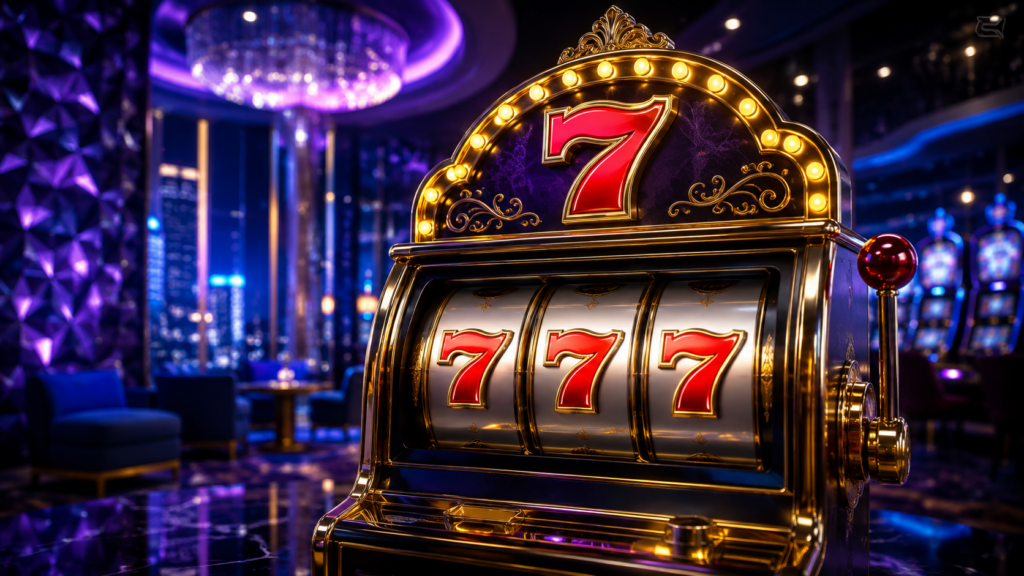
Eventually, three 7s lined up across a payline became one of the most iconic gambling images in popular culture.
Even someone who has never played a slot game knows what 777 is supposed to suggest.
And that is some impressive branding for three identical numbers.
Why 777 Became the Ultimate Casino Combination
One seven is lucky.
Two sevens?
Clearly we’re getting serious.
Three sevens?
Now we’re entering neon-sign territory.
The image of 777 became particularly powerful because slot machines often reward matching symbols.
Three identical high-value symbols naturally look important.
When those symbols are already considered lucky, the effect becomes even stronger.
Suddenly, 777 doesn’t just look like a winning combination.
It looks like the winning combination.
Movies, TV shows, advertisements, video games, and casino imagery reinforced that idea for decades.
Picture a fictional jackpot scene.
What do you imagine?
Probably flashing lights.
Coins.
Someone screaming.
And somewhere on the machine?
7 – 7 – 7.
Poor cherries never had a chance.
The Psychology Behind Lucky Seven
There is another reason seven works so well in slot games: people genuinely like the number.
When researchers ask people to choose a random number between one and ten, seven frequently appears as a popular answer.
Why?
Part of the reason may be that seven feels unusual without feeling strange.
Five seems too obvious.
Ten seems too neat.
One feels boring.
Seven sits comfortably in the middle while still feeling slightly unpredictable.
It has also been reinforced as a “special” number throughout our lives.
Lucky number seven.
Seven wonders.
Seven days.
Seven seas.
Seven dwarfs.
And yes, apparently Snow White accidentally contributed to casino symbolism.
The more often we hear that seven is meaningful, the more familiar that association becomes.
So when it appears inside a slot game, the symbol already carries emotional baggage.
Good baggage, for once.
Slot Designers Love Symbols Players Understand Instantly
Modern slot games can be extremely detailed.
Some have elaborate bonus rounds, multipliers, Wilds, Scatters, jackpots, expanding symbols, cascading reels, Hold & Spin features and enough animations to make your phone wonder what it did wrong.
But even complicated games still benefit from familiar symbols.
Players need visual shortcuts.
A crown looks valuable.
Gold looks valuable.
Diamonds look valuable.
And seven?
Seven looks lucky.
Game designers can communicate an idea before the player even reads the paytable.
A giant golden 7 covered in flames immediately feels more important than, for example, a symbol shaped like an office stapler.
No disrespect to staplers.
They just aren’t screaming jackpot.
Why Are Slot Machine Sevens Usually Red?
Here’s another casino mystery hiding in plain sight.
Why is the traditional slot machine 7 often red?
There isn’t one universal rule requiring it, but red makes perfect sense from a design perspective.
It is bold.
It attracts attention.
And it contrasts strongly against dark backgrounds.
And it carries emotional associations with excitement, energy, urgency, passion, and action.
In other words, red is not exactly shy.
Combine that with an already powerful lucky symbol and you get something that visually dominates the reels.
That’s why the classic red seven became such a strong part of traditional slot aesthetics.
Modern developers sometimes turn it gold, diamond-covered, fiery, electric, metallic or futuristic.
But the red 7 remains the casino equivalent of a leather jacket.
The classic still works.
Seven Fits Perfectly With Classic Slot Design
Classic slot games tend to use very simple visual language.
Think:
- cherries
- lemons
- bells
- BAR symbols
- horseshoes
- stars
- 7s
Nothing requires much explanation.
And that’s intentional.
Traditional slots were built around speed and recognition.
Players needed to understand what appeared on the reels almost instantly.
The number 7 fits perfectly into that environment because it is both simple and loaded with meaning.
Even today, developers creating retro-inspired slot games often bring the seven back.
They may update the graphics, add animations and attach modern features, but that classic symbol immediately tells players:
“You know this kind of game.”
Nostalgia accomplished in one character.
Modern Slots Haven’t Abandoned Seven Either
You might expect the number 7 to disappear as slot games become more cinematic.
It hasn’t.
Instead, developers keep reinventing it.
Modern games may feature:
Golden 7s.
Flaming 7s.
Diamond 7s.
Lucky 7s.
Double 7s.
Triple 7s.
At this rate, somebody is probably pitching a Cyber Dragon Mega Flaming 7 somewhere.
And honestly?
It would probably look great.
The symbol survives because it is flexible.
It can appear in a simple retro fruit machine or a flashy modern slot without feeling completely out of place.
That is rare.
A symbol that worked decades ago still communicates the same basic message today:
This one matters.
Does Seven Actually Make You Luckier?
And now we arrive at the question every lucky-number enthusiast was hoping we wouldn’t ask.
Does choosing a slot containing sevens improve your chances of winning?
No.
The presence of lucky symbols does not change the underlying randomness of a legitimate slot game.
Modern online slot outcomes are determined by a Random Number Generator, commonly called an RNG.
The theme, animations and symbols are part of how those results are presented visually.
A slot covered in lucky 7s isn’t magically luckier than one covered in pirates, aliens or suspiciously wealthy pigs.
Your grandmother’s lucky number may be emotionally powerful.
The RNG remains unmoved.
That distinction matters.
Casino symbols are part of the entertainment and design of the game, not a prediction system.
So if seven is your favorite number, enjoy seeing it.
Just don’t expect it to negotiate with mathematics on your behalf.
Then Why Do Lucky Symbols Feel So Powerful?
Because humans don’t experience games as spreadsheets.
We experience colors.
Sounds.
Animations.
Near-misses.
Patterns.
Themes.
Symbols.
Anticipation.
A familiar lucky symbol can make a moment feel more exciting even when it doesn’t influence the mathematical mechanics.
Imagine two symbols landing on a reel.
One is a plain gray square.
The other is a huge glowing golden 7 surrounded by sparks.
Mathematically, their value depends entirely on the game’s rules.
Emotionally?
Come on.
We’re watching the seven.
This is where good slot design works.
It turns mathematical outcomes into moments.
Seven Isn’t the Only Lucky Casino Number
Seven may be the superstar, but the casino world has several other numbers with lucky reputations.
8, for example, is particularly associated with prosperity and good fortune in Chinese culture.
That is why you’ll often see 8s, 88s, or 888s incorporated into casino games designed around Asian themes.
3 is another number frequently associated with luck, balance and completeness.
And then there is 13, which has taken the opposite career path.
In many Western cultures, thirteen is considered unlucky.
Which naturally makes it extremely useful for spooky or horror-themed games.
Casino designers understand cultural symbolism.
A number isn’t always just a number.
Sometimes it arrives with centuries of storytelling attached.
Lucky Symbols Are Really About Storytelling
This is what makes casino symbols interesting.
A developer could technically fill every reel with random geometric shapes.
Circle.
Triangle.
Square.
Slightly different square.
Congratulations, we’ve invented the world’s least exciting slot.
Instead, games use symbols people already understand emotionally.
Gold means treasure.
Diamonds mean wealth.
Hearts mean love.
Horseshoes mean luck.
Four-leaf clovers mean fortune.
And sevens?
They mean that something exciting might be happening.
These associations help a game create atmosphere before a player understands anything about its mechanics.
That is powerful visual storytelling.
From Mechanical Reels to Digital Screens
The history of the seven symbol also mirrors the history of slots themselves.
Older machines had physical mechanical reels.
Symbols had to be simple enough to print clearly and recognize quickly as the reels stopped.
Modern online slots don’t have that limitation.
Developers can create elaborate 3D symbols, animated characters, transformations and visual effects.
Yet seven survived the transition.
Think about that.
Slots went from metal machines with physical levers to games running on smartphones.
The technology completely changed.
The humble 7 simply put on some better graphics and came along for the ride.
Respect.
Why Nostalgia Matters in Casino Games
Classic casino imagery has another advantage: nostalgia.
Even younger players who never spent years playing traditional mechanical machines recognize the aesthetic.
Fruit.
Bells.
BARs.
Sevens.
It’s part of our cultural image of what a slot machine looks like.
Developers can use those symbols to create an instant retro feeling.
Then they mix them with modern features.
A game might look like an old-school fruit machine while offering Wild mechanics, bonus rounds, jackpots or multipliers that couldn’t exist on the earliest machines.
It becomes a combination of familiarity and novelty.
And the number seven sits right in the middle of that bridge between old and new.
The World’s Most Successful Single-Digit Celebrity?
Think about the competition.
Zero has mathematics.
One has motivational speeches.
Three has triangles.
Nine gets cat lives.
But seven?
Seven got casinos.
That’s difficult to beat.
Its popularity wasn’t created by slot machines, but slot machines helped turn it into one of the most recognizable symbols of luck in modern entertainment.
Today, seeing three bright 7s immediately communicates casino excitement even without context.
No logo.
No explanation.
And no instructions.
Just:
777
And your brain already knows the vibe.
Final Spin: Why Seven Is Here to Stay
The popularity of the number 7 in slot games isn’t the result of one invention or one casino tradition.
It happened because several things came together perfectly.
Seven already had centuries of lucky symbolism behind it.
Early slot designers needed simple and recognizable symbols.
Players immediately understood what seven represented.
Casinos, movies and popular culture reinforced the connection.
And modern game developers discovered that the symbol still works just as well on digital reels as it did on mechanical ones.
That’s why seven isn’t disappearing anytime soon.
It may become golden.
It may catch fire.
And it may glow, explode, expand or arrive with enough visual effects to qualify for its own action movie.
But underneath all that?
It’s still the same lucky number players have recognized for generations.
And if you’re curious to see which lucky symbols are waiting on the reels, explore the games at Eternal Slots and find your next favorite.
Just remember: lucky seven can bring plenty of casino atmosphere.
The RNG, unfortunately, still refuses to believe in superstition.

You might also like





Leave A Reply